MASTERPIECE COLLECTION · 1 MODEL
Custom Dry-Aging Cabinets for Beef
Engineered and built in our 6,600 m² Foshan atelier. Send a room schedule or a sketch — we return a marked-up 3D concept and a costed bill of materials.
TÜV Rheinland Audited · 8 Items
100% Finished-Goods Inspection
MOQ 1 Unit · No Batch Threshold
FOB · CIF · CFR · EXW
D/P · T/T · L/C Accepted
01 — THE COLLECTION
A dry-aging cabinet is a small climate room with a hygiene requirement attached. Beef loses water, enzymes work, and the surface has to stay dry enough to form a crust without drying the interior. A custom aging cabinet is therefore specified around three variables — temperature, relative humidity and air exchange — plus a fourth that is usually forgotten: how the cabinet is cleaned between programmes. We build aging cabinet units in Foshan for steakhouses, BBQ restaurants and private kitchens.
What dry aging actually requires
The commonly used band is close to 1–3 °C with relative humidity in the high seventies to mid eighties, with gentle airflow and controlled air exchange. Within that band the result is a matter of time and surface management, not of a single setpoint. A steak aging cabinet that holds temperature but not humidity will dry the exterior too fast and leave the centre unchanged.
A stainless steel aging cabinet with precise temperature and humidity control is the specification for commercial kitchens: stainless because of cleaning, precise control because the process is slow and unforgiving.
Cabinet types
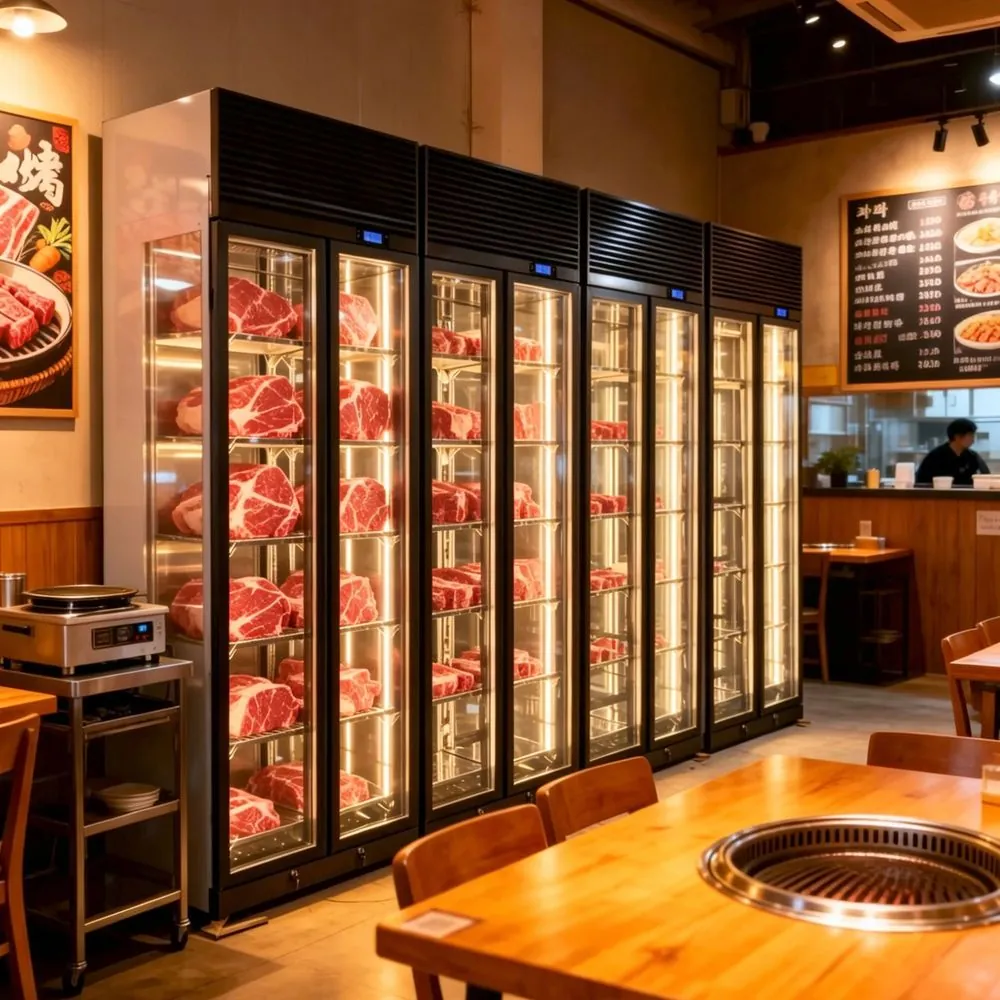
H3: Commercial — a premium commercial dry-aging cabinet for steakhouses is sized to the menu, not to the room: how many covers per week, what weight loss is acceptable, and how the product is rotated. A commercial aging cabinet with glass display is also a sales tool; the glass-display beef aging cabinet for BBQ restaurants turns the process into theatre, which is a legitimate specification rather than a gimmick.
H3: Home — a compact smart-controlled beef aging machine for home use suits a private kitchen with occasional programmes. The constraint is usually ventilation and power, not capacity.
H3: Specialist — a professional dry-aging cabinet for black truffles or a cabinet used for other charcuterie runs a different humidity profile from beef; the cabinet has to be configurable rather than fixed.
Sizing the cabinet to the menu
Capacity should be set by covers per week and by the aging period you intend to run, not by the largest number on a specification sheet. A steakhouse serving forty covers a week on a twenty-one day programme needs a different cabinet from one running sixty-day programmes for a tasting menu, even when both hold the same weight. We size the racking around the cuts actually used — rib, strip, sirloin or whole primal — because a rack designed for primals wastes space on individual steaks, and the reverse is worse.
Meat conditioning, named properly
A meat conditioning cabinet or beef conditioning cabinet is the same equipment described by function rather than by outcome; a dry-aging unit is the same again in trade language. A high-end aging cabinet in a residential setting usually adds display glass, quieter operation and a finish that belongs in a kitchen rather than a butchery.
A custom steak cabinet is a specification exercise: racking for the cuts used, a salt wall if requested, a drip route, and a door that seals without a latch that fails in a wet environment.
Salt walls, airflow and cleaning
Salt walls are often requested for humidity buffering and for the visual. They work, within limits: salt absorbs and releases moisture, but it does not replace a humidity sensor and a control loop. Cleaning between programmes is the part that decides whether a metal aging cabinet stays hygienic — removable racks, coved corners and a drain route are design decisions, not cleaning instructions.
Frequently asked questions
What temperature and humidity should dry aging run at?
The usual band is around 1–3 °C and high-seventies to mid-eighties relative humidity, with gentle airflow. The exact profile depends on the product and the desired weight loss, and we set it with you rather than shipping a default.
Can one cabinet run beef and other products?
Only if the control profile is configurable and the cabinet can be cleaned between programmes. A fixed-profile cabinet will do one thing well.
Does it need a drain?
A condensate route is required. A cabinet without one will pool water at the base.
What electrical supply?
110 V / 60 Hz for North America, 220 V / 50 Hz for Europe and most other markets, confirmed at engineering review.
Is a glass door a problem for aging?
Glass adds heat gain and light exposure. For a display cabinet we specify insulated glass and low-UV lighting; for a back-of-house unit a solid door is more efficient.
What is the minimum order?
One unit. The inspection record is the same whether you order one or twenty.
Related collections and models
02 — MODELS
Custom Aging Cabinets: 1 Engineered Model
Every model below is built to order. Dimensions, finish and refrigeration capacity are specified per project — nothing here is a stock item.
START A CONVERSATION
Specify a Custom Aging Cabinets Project
Send drawings, a room schedule or a reference photograph. A named engineer reviews it and replies with a 3D concept and a costed BOM — usually within 48 hours.